
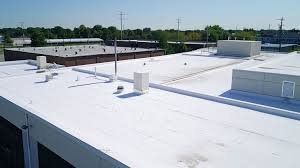
A property manager in Newton Centre called in February 2024 with a problem that had been building for three winters. The flat roof over her four-unit residential building on Langley Road was losing a battle with ice and freeze-thaw cycles. The previous contractor had installed TPO six years earlier. It looked fine. No visible tears, no obvious punctures. But every spring, she was pulling ceiling tiles out of the top-floor unit because water had found its way in somewhere the eye could not see.
The diagnostic inspection revealed the real culprit: the TPO membrane had been mechanically fastened rather than fully adhered, and the fastener plates were lifting along the north face where winter wind loading was highest. Water was wicking under the membrane at each fastener point, freezing, expanding, and slowly compromising a system that should have lasted 25 years.
The repair cost $14,200. A fully adhered installation would have added roughly $3,800 to the original job.
That $3,800 decision became a $14,200 lesson.
This guide is for Newton building owners and property managers who want to make the right system decision the first time. Whether you manage a commercial property, a multi-family building, or own a Newton home with a flat addition roof, the choice between TPO, EPDM, and modified bitumen is consequential in ways that most contractors will not explain unprompted.
What Makes Flat Roofing Different in New England?
Before comparing systems, you need to understand why the New England climate creates specific performance demands that a contractor in Arizona or Georgia simply does not face.
Newton’s climate subjects flat roofing membranes to roughly 100 freeze-thaw cycles per year. The temperature swings between January’s lows (averaging around 18 degrees Fahrenheit) and July’s highs (averaging near 82 degrees) represent a thermal range of approximately 64 degrees that the membrane must accommodate through expansion and contraction every single year. Over 20 years, that adds up to roughly 2,000 expansion-contraction cycles before the material even approaches its expected end of life.
Add to this the ice dam dynamics unique to Massachusetts buildings, the wet snow loading that Boston-area roofs absorb in major nor’easter events, and the UV exposure from summer sun reflecting off white TPO membranes, and you have a performance environment that accelerates failure in systems not properly specified or installed for the conditions.
The second factor specific to Newton is the building stock itself. Newton’s commercial and multi-family building inventory skews toward mid-century construction with low-slope roofs originally built for coal tar pitch or built-up roofing systems. When those systems need replacement today, the substrate conditions, drainage geometry, and mechanical penetration density often complicate what looks like a straightforward re-roofing job.
Neither factor eliminates any of the three main systems from consideration. All three can perform well in Newton’s climate when properly specified, installed, and maintained. But each has distinct strengths and vulnerabilities that matter enormously in practice.
TPO Roofing in Newton, MA: The Hot Seam System That Dominates New Construction
Thermoplastic polyolefin (TPO) has become the dominant flat roofing membrane in commercial new construction across the United States since roughly 2010, and Newton is no exception. Walk through Newton’s commercial districts along Needham Street or Washington Street, and most of the newer flat-roofed buildings have TPO up top.
The reasons for TPO’s market dominance are legitimate. Hot air welded seams, when executed properly, create bonds that are stronger than the membrane itself. The white reflective surface delivers meaningful energy savings in Newton’s shoulder seasons. Material costs are competitive with EPDM, and the system is compatible with virtually all common insulation types, including polyisocyanurate board, which most Newton commercial roofs use.
TPO from major manufacturers, including Carlisle SynTec (SecureTape and Sure-Weld lines), GAF (EverGuard series), Firestone (UltraPly), and Johns Manville (JM TPO), carries typical manufacturer warranties ranging from 15 to 30 years when installed by certified contractors.
Here is where the honest assessment gets complicated. TPO formulations varied significantly in quality during the early 2000s, and some of those early-generation membranes installed on Newton buildings are now failing in ways that generated real scepticism about the product. The formulation stability has improved substantially with the current generation, but experienced Newton contractors carry some justified residual caution.
The fully adhered versus mechanically fastened installation decision matters enormously in Newton’s wind environment. The Langley Road building case at the opening is representative of a pattern that repeats across Middlesex County. Mechanically fastened TPO costs less to install. In Newton’s exposed rooftop environments with significant wind loading and freeze-thaw cycling, fully adhered systems dramatically outperform mechanically fastened ones in long-term water tightness.
Current installed costs for TPO in Newton as of early 2026 run $5.50 to $9.00 per square foot for standard commercial applications, with fully adhered systems at the higher end. A 3,000 square foot commercial flat roof in Newton Centre would cost approximately $16,500 to $27,000 fully installed.
EPDM Roofing in Newton, MA: The Veteran Membrane With a Long Track Record
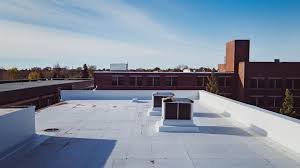
Ethylene propylene diene monomer (EPDM), commonly called rubber roofing, has been the workhorse of commercial flat roofing in New England for more than 40 years. There are EPDM roofs on Newton buildings installed in the 1980s that are still performing adequately today with proper maintenance. That longevity track record is not marketing. It is documented installation history across tens of thousands of Northeastern commercial properties.
EPDM’s core advantage in New England is flexibility at low temperatures. While TPO and modified bitumen can become brittle in extreme cold, EPDM remains flexible down to approximately minus 40 degrees Fahrenheit. For Newton buildings that experience sharp overnight temperature drops in January and February, this material property reduces cracking risk at membrane penetrations, flashing terminations, and corner details where rigid membranes under thermal stress are most vulnerable.
The traditional weakness of EPDM has been its seam technology. Early EPDM systems relied on contact cement and tape seams that degraded over time. Modern EPDM seam systems from manufacturers like Carlisle (Sure-Seal), Firestone (RubberGard), and Versico have substantially improved through the use of EPDM-specific cover tape and lap sealant systems, but seam integrity remains a more critical maintenance point for EPDM than for hot-welded TPO.
EPDM’s black colour absorbs heat rather than reflecting it. For Newton commercial buildings with rooftop HVAC equipment, this can slightly increase cooling loads in summer. Some building owners address this with light-colored EPDM coatings or white ballast stone, but those solutions add cost and complexity.
Installed costs for EPDM in Newton run $4.50 to $8.00 per square foot. EPDM is generally somewhat less expensive than TPO for equivalent coverage, making it attractive for budget-constrained projects. EPDM shines most specifically on Newton buildings with high foot traffic across the roof surface for HVAC maintenance access. The membrane tolerates puncture impact better than TPO and resists weathering from rooftop equipment vibration more predictably.
Modified Bitumen in Newton, MA: The Hybrid System That Handles Complexity Best
Modified bitumen (mod bit) is the evolution of the traditional built-up roofing system that covered most commercial Newton buildings through the mid-20th century. A modern modified bitumen system uses asphalt modified with either styrene-butadiene-styrene (SBS) polymers or atactic polypropylene (APP) polymers, applied in multiple layers to create a redundant waterproofing assembly.
SBS-modified bitumen, the more common variant in New England commercial applications, is cold-flexible and torch or cold-applied. APP-modified bitumen, applied with a propane torch in what contractors call torch-down roofing, is harder and more UV-resistant but less flexible at low temperatures.
Modified bitumen is the system of choice in Newton for three specific situations that no competitor handles as well.
First, complex roofs with numerous penetrations. Older Newton commercial buildings and multi-family properties often have dense clusters of HVAC curbs, plumbing vents, gas line penetrations, and structural elements that require detailed flashing work. Modified bitumen’s self-flashing capability creates waterproofing continuity that single-ply systems cannot match in complex conditions.
Second, buildings requiring rooftop walking surfaces. Modified bitumen granule-surfaced cap sheets provide inherent slip resistance and abrasion protection for roofs with regular maintenance access. Adding a mineral-surfaced cap sheet eliminates the need for walk pads that single-ply systems require.
Third, re-roofing over legacy built-up systems. When a Newton commercial building needs to replace a coal tar pitch or asphalt built-up system, modified bitumen often provides the smoothest transition because it works compatibly with the existing substrate conditions and drain geometry the original system was designed around.
Installed costs for modified bitumen in Newton run $5.00 to $9.50 per square foot for a standard two-layer system. A 3,000 square foot re-roof with modified bitumen typically takes two to three days versus one to two days for a single-ply membrane installation.
Side-by-Side Comparison: TPO vs. EPDM vs. Modified Bitumen for Newton Buildings
| Factor | TPO | EPDM | Modified Bitumen |
| Installed cost (Newton, 2026) | $5.50–$9.00/sq ft | $4.50–$8.00/sq ft | $5.00–$9.50/sq ft |
| Expected lifespan (New England) | 20–30 years | 25–40 years | 20–30 years |
| Cold temperature flexibility | Moderate | Excellent | Moderate (SBS) / Fair (APP) |
| Seam strength | Excellent (heat welded) | Good (modern tape) | Excellent (torch/self-adhered) |
| Energy efficiency | Best (white reflective) | Fair (black absorbs heat) | Good (granule cap reflects) |
| Complex penetration handling | Good | Good | Excellent |
| Foot traffic tolerance | Good (with walk pads) | Excellent | Excellent (granule cap) |
| Maintenance requirements | Low | Moderate (seams) | Low to moderate |
| Best Newton application | New construction, flat additions | High-traffic roofs, budget projects | Complex older buildings, re-roofing legacy systems |
What About Ponding Water on Newton Flat Roofs?
Ponding water is the flat roof issue that Newton building owners worry about most, and for good reason. A roof that holds standing water for more than 48 hours after a rain event is underperforming, and all three membrane systems can be degraded by sustained ponding over time.
Here is what most contractors will not tell you upfront: the ponding water problem is almost never a membrane problem. It is a drainage design problem. No membrane choice eliminates ponding water on a roof with an inadequate drainage slope or blocked drains.
The standard for flat roof drainage is a minimum slope of 1/4 inch per foot toward the roof drains. Many older Newton commercial buildings fall below this standard because their original drainage systems were designed around historical roofing assemblies, and subsequent insulation additions have further flattened the roof plane.
Tapered insulation systems, installed beneath the membrane to create a positive drainage slope, solve this problem during re-roofing projects. Tapered polyisocyanurate insulation from manufacturers like Hunter Panels, Atlas, or Carlisle is cut to specific geometric slopes that direct water to drain locations regardless of the underlying structural geometry.
Among the three membrane systems, TPO shows the most sensitivity to sustained ponding because chemical plasticisers in early-generation TPO formulations were vulnerable to water absorption over time. EPDM is the most tolerant of occasional ponding. Modified bitumen’s granule surface can retain moisture and promote algae growth in chronic ponding conditions, but the waterproofing integrity of the membrane itself is not significantly compromised.
How Newton’s Commercial Building Code Affects Your Flat Roof Decision
Newton Inspectional Services enforces the Massachusetts State Building Code (9th Edition, based on the 2015 International Building Code with Massachusetts amendments) for commercial roofing projects. Several requirements affect system selection in ways that building owners should understand before accepting contractor proposals.
Energy code requirements (Massachusetts Stretch Energy Code applies in Newton) mandate minimum R-values for commercial roof assemblies. For most commercial buildings in Newton’s climate zone (Zone 5A), the minimum continuous insulation R-value is R-30 for roofs above conditioned space. This requirement typically drives insulation thickness to 4.5 to 6 inches of polyisocyanurate, which affects the overall roof system height and can create complications at parapets and door thresholds on re-roofing projects.
Windstorm resistance requirements affect membrane attachment method selection. Newton’s proximity to the coast places commercial buildings in a wind speed design zone that requires uplift resistance calculations for mechanically fastened membrane systems. Fully adhered systems generally achieve the required uplift resistance more easily and should be specified as the default for Newton commercial applications.
Frequently Asked Questions: Flat Roof Systems for Newton Buildings
What is the best flat roof material for cold climates like Newton, MA?
For pure cold-climate durability, EPDM edges out the competition because it remains flexible at temperatures that can stress TPO and modified bitumen membranes. For overall performance balancing energy efficiency, seam strength, and cost, fully adhered TPO is currently the leading specification for Newton commercial new construction. For complex older buildings, modified bitumen’s redundant layer system provides the most reliable waterproofing continuity.
How long does a TPO roof last in Massachusetts?
A properly installed, fully adhered TPO roof from a major manufacturer should last 20 to 30 years in Newton’s climate. Mechanically fastened TPO in wind-exposed locations may require significant repairs within 10 to 15 years. Annual inspections and prompt seam repairs extend service life substantially.
Is EPDM or TPO better for New England winters?
EPDM has a better cold-temperature flexibility profile. TPO has stronger seams and better energy performance. For Newton buildings prioritising long-term durability with minimal seam maintenance, EPDM is defensible. For buildings where energy efficiency and seam performance matter more, fully adhered TPO wins. Most experienced Newton flat roof contractors can make either system work well.
How much does flat roof replacement cost in Newton, MA?
As of early 2026, expect $4.50 to $9.50 per square foot installed, depending on system choice, insulation requirements, penetration complexity, and tear-off conditions. A 3,000 square foot commercial flat roof in Newton typically runs $13,500 to $28,500 fully installed with permit, tapered insulation, and drain upgrades if needed.
What is modified bitumen roofing, and where is it best used?
Modified bitumen is an asphalt-based membrane enhanced with rubber (SBS) or plastic (APP) polymers for improved flexibility and weather resistance. It is applied in multiple layers and is particularly effective on complex older Newton buildings with dense penetration fields, on re-roofing projects over legacy built-up systems, and on roofs requiring durable walk surfaces without separate walk pads.
How do I stop ponding water on my flat roof?
The correct solution is improving the drainage slope, not changing membranes. Options include tapered insulation installation during re-roofing to create a positive slope, adding roof drains or scuppers at low points, and ensuring existing drains are clear and sized for the roof area they serve. Address drainage first; the membrane choice is secondary to drainage geometry.
What flat roof system has the longest lifespan?
EPDM, when properly installed and maintained with attention to seam integrity, has documented performance histories exceeding 40 years on New England commercial buildings. TPO and modified bitumen systems both target 20 to 30-year lifespans under good conditions. Lifespan is more sensitive to installation quality, drainage design, and maintenance frequency than to membrane brand selection.
Do flat roof systems need annual maintenance in Newton?
Yes. Annual inspections are strongly recommended for all three systems, ideally in fall before winter weather arrives. Inspections should cover seam and flashing conditions, drain clearing, membrane surface for punctures or blisters, and parapet wall cap conditions. Budget $300 to $600 annually for a professional inspection and minor maintenance on an average Newton commercial flat roof.
Making the Right Call for Your Newton Building
The property manager on Langley Road eventually had her TPO system fully re-adhered over the problem areas and upgraded to a fully adhered specification across the remaining roof surface. Two winters later, her top-floor tenants stopped finding ceiling tiles on the floor in March.
The right system for your Newton building depends on factors that generic online comparisons cannot settle: your building’s age and substrate conditions, your drainage geometry, how often people access the roof, your energy efficiency priorities, and the specific installation capabilities of the contractor you hire.
That last factor is not a minor caveat. The best system specification in the world underperforms when installed by a crew that cuts corners on seam welding temperatures, membrane adhesion dwell time, or flashing details at penetrations. This is why contractor selection and system selection are inseparable decisions for Newton flat roofs.
For current Newton market conditions: for new construction and clean re-roofs with good drainage, specify fully adhered TPO from Carlisle, GAF, or Firestone using a manufacturer-certified installer. For complex older buildings with legacy built-up systems and dense penetration fields, seriously evaluate modified bitumen. For budget-sensitive projects or buildings with heavy rooftop maintenance traffic, EPDM from Firestone or Carlisle earns its reputation.
What is the biggest flat roof mistake you have seen on Newton commercial buildings? Leave your experience in the comments. Building owners and property managers who have navigated this decision are the best source of real-world guidance on what works in our specific climate and building stock.
Pricing and code references in this guide reflect Newton, MA market conditions and Massachusetts State Building Code (9th Edition) requirements as of early 2026. Consult a licensed Massachusetts commercial roofing contractor for specifications appropriate to your specific building.